 Image 1 of 4
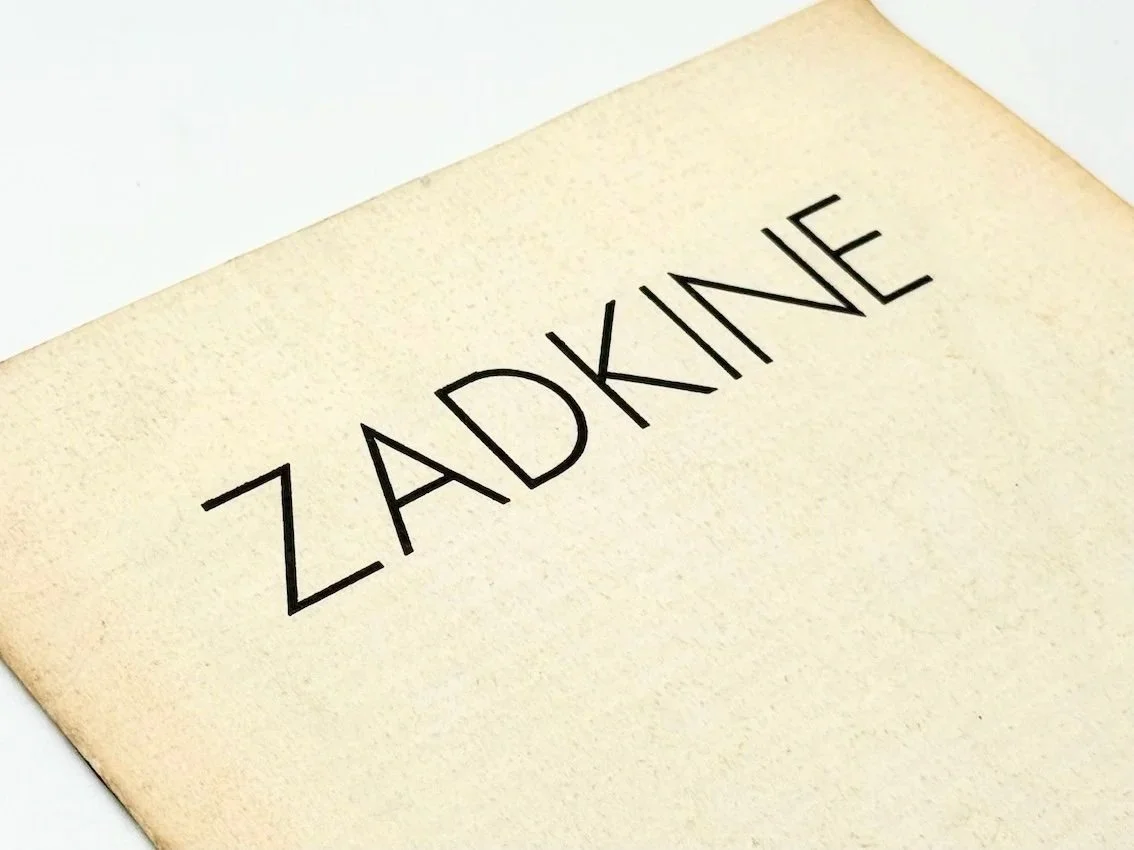 Image 2 of 4
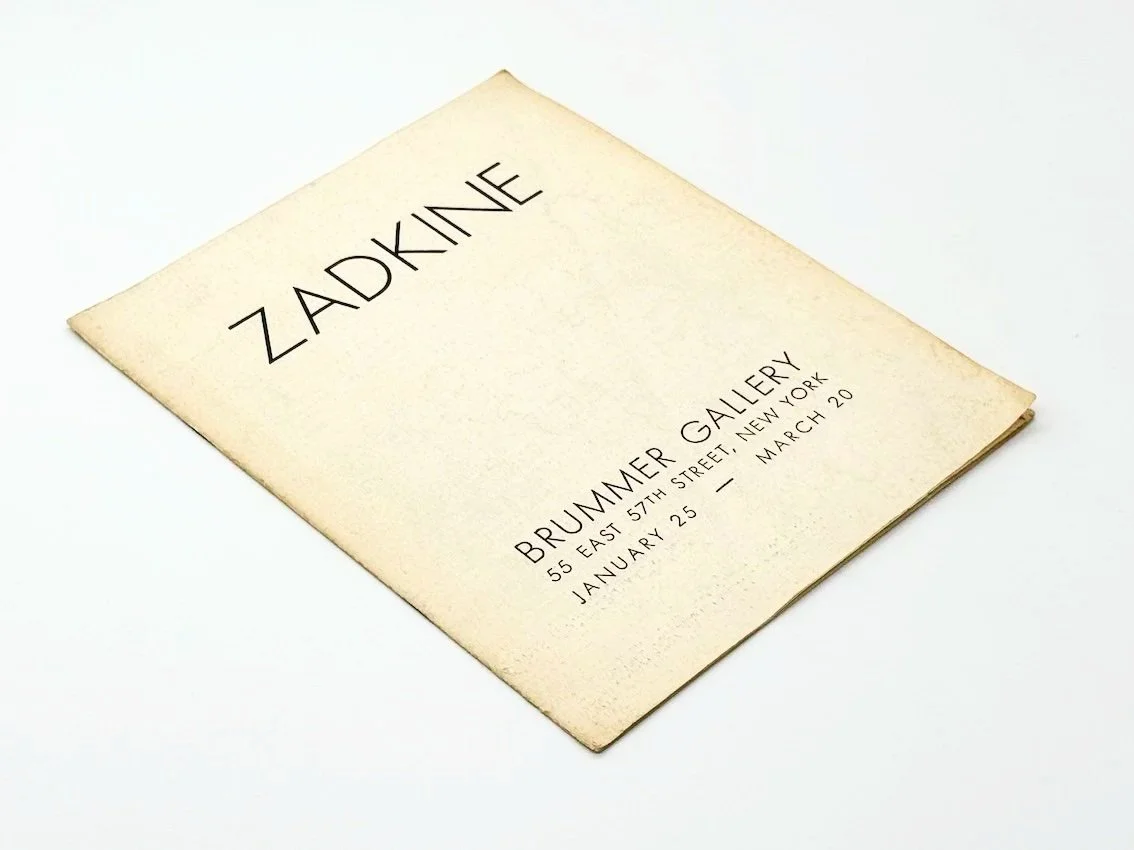 Image 3 of 4
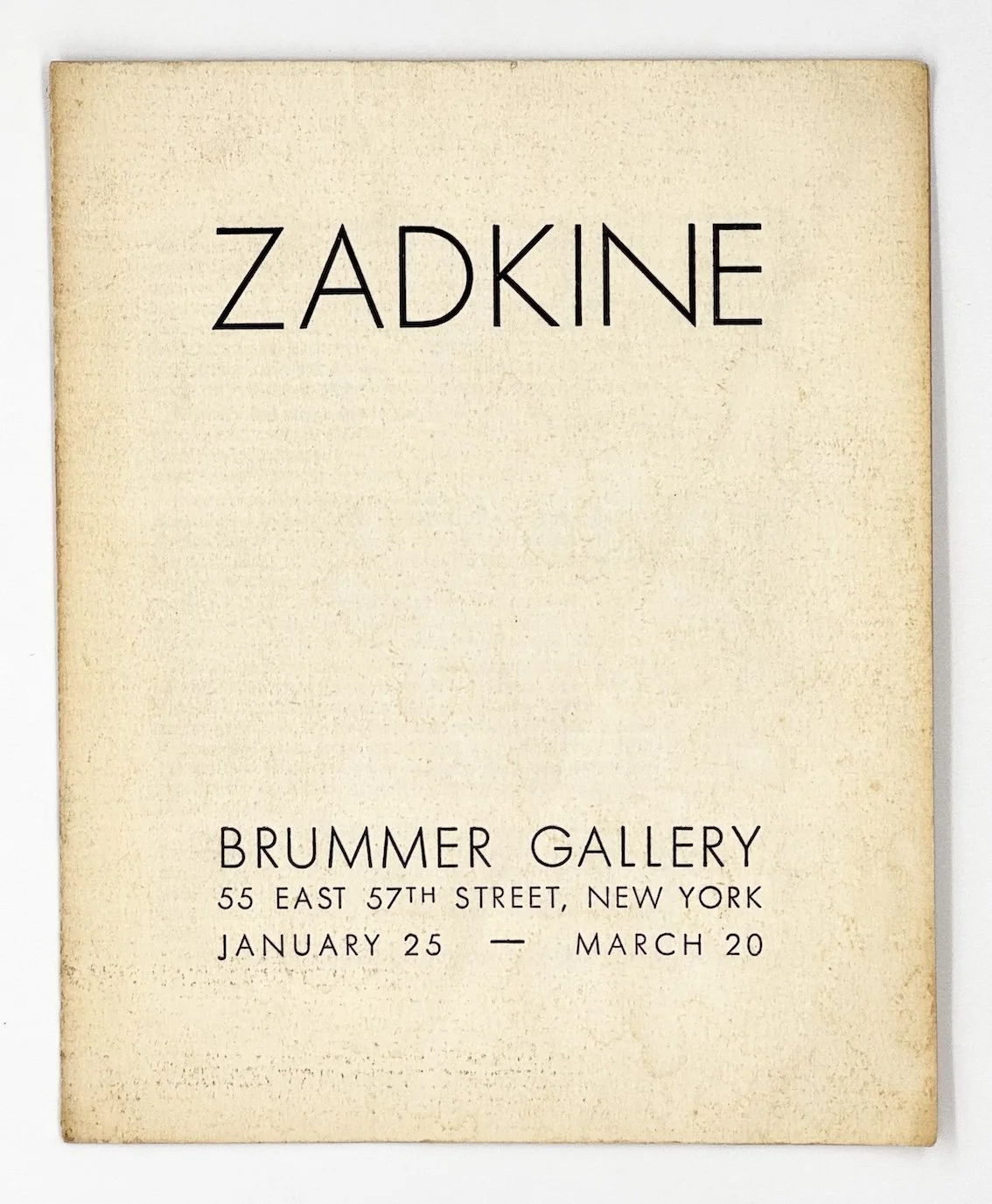 Image 4 of 4
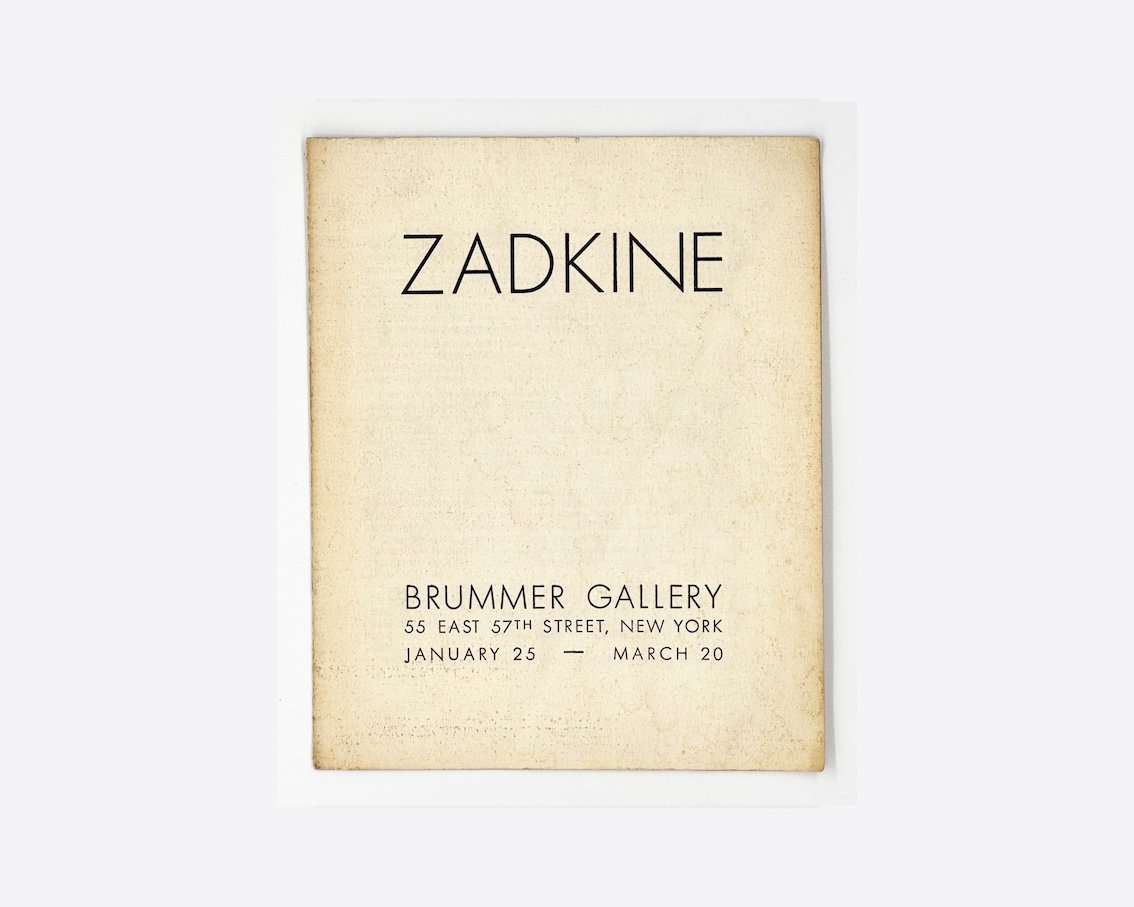
Catalogue of an exhibition of works by Ossip Zadkine held at Brummer Gallery, New York, 25 January – 20 March, 1937. Includes a text by the art historian critic Andre de Ridder, and a text by Allan Ross Macdougall. list of 33 works.
The following review of the show by Edward Alden Jewell appeared in The New York Times on January 26, 1937:
Sculpture display by Zadkine opened: ’First Complete Showing in America' of His Works Are on View in Brummer Gallery.
A large one-man show of sculpture by Ossip Zadkine opened yesterday at the Brummer Gallery, 55 East Fifty-seventh Street, to remain until March 20. This is announced as the "first complete showing in America," and is certainly comprehensive with respect to the last decade. It does not contain anything done earlier than 1927. Zadkine is a modern sculptor who has done much interesting experimentation and produced examples that are imaginative, sound and plastically excellent, whatever the controversy that may have been or may still be precipitated on the score of the idiom he employs. This sculptor, it may be felt, does not always (what artist does?) present either his thesis or his argument in the clearest possible terms. But there are pieces in this show that have been carried to a powerful and cogent conclusion, while the sculptor's general trend is at all times evident. Yes,
Abstract the thesis proves from beginning to end. And one may feel that often his sculpture allies itself in some degree with painting. A prevalence of flat planes and angles, decoratively conceived, helps to create this kinship. Also shadows play an important rôle. Yes, again and again it brings painting to mind. On the other hand, the work is in large measure thoroughly sculptural, full of movement within the plastic design and distinguished now and then by striking contour.
One of Zadkine's favorite devices is to make a form, especially a face, concave instead of convex. As a matter of fact, this device has enjoyed rather widespread use among the modernists. It may be dismissed, if you like, as no more than a mannerism; yet having adopted it, Zadkine can make telling the decorative contrasts that result when concave and convex are rhythmically juxtaposed, as in the group called "Intimacy" or in the "Portrait of Mrs. M. L."
Among the larger works are "Homo Sapiens"—which, if in three-dimensional terms, resembles Chirico; "Concerto for two violins" (both of these pieces done in 1936); the heroic “Orpheus,” a plaster version of the original in the Musee d'Art Moderne, Paris (1932) and a "Niobe" in wood awkwardly cut off just below the knees. The last mentioned figure, along with a couple of small groups in bronze, have been lent by Bernard Davis of Philadelphia.
Title: Zadkine
Authors: Andre de Ridder, Allan Ross Macdougall
Publisher: Brummer Gallery, New York
Publication Date: 1937
Format: stapled wraps
Pages: 8 pp.
Language: English
Condition: very good. Slightly creased and tanning to edges
Provenance: The Library of Rod Hill
Stock Number: RB05092 RH 215
Catalogue of an exhibition of works by Ossip Zadkine held at Brummer Gallery, New York, 25 January – 20 March, 1937. Includes a text by the art historian critic Andre de Ridder, and a text by Allan Ross Macdougall. list of 33 works.
The following review of the show by Edward Alden Jewell appeared in The New York Times on January 26, 1937:
Sculpture display by Zadkine opened: ’First Complete Showing in America' of His Works Are on View in Brummer Gallery.
A large one-man show of sculpture by Ossip Zadkine opened yesterday at the Brummer Gallery, 55 East Fifty-seventh Street, to remain until March 20. This is announced as the "first complete showing in America," and is certainly comprehensive with respect to the last decade. It does not contain anything done earlier than 1927. Zadkine is a modern sculptor who has done much interesting experimentation and produced examples that are imaginative, sound and plastically excellent, whatever the controversy that may have been or may still be precipitated on the score of the idiom he employs. This sculptor, it may be felt, does not always (what artist does?) present either his thesis or his argument in the clearest possible terms. But there are pieces in this show that have been carried to a powerful and cogent conclusion, while the sculptor's general trend is at all times evident. Yes,
Abstract the thesis proves from beginning to end. And one may feel that often his sculpture allies itself in some degree with painting. A prevalence of flat planes and angles, decoratively conceived, helps to create this kinship. Also shadows play an important rôle. Yes, again and again it brings painting to mind. On the other hand, the work is in large measure thoroughly sculptural, full of movement within the plastic design and distinguished now and then by striking contour.
One of Zadkine's favorite devices is to make a form, especially a face, concave instead of convex. As a matter of fact, this device has enjoyed rather widespread use among the modernists. It may be dismissed, if you like, as no more than a mannerism; yet having adopted it, Zadkine can make telling the decorative contrasts that result when concave and convex are rhythmically juxtaposed, as in the group called "Intimacy" or in the "Portrait of Mrs. M. L."
Among the larger works are "Homo Sapiens"—which, if in three-dimensional terms, resembles Chirico; "Concerto for two violins" (both of these pieces done in 1936); the heroic “Orpheus,” a plaster version of the original in the Musee d'Art Moderne, Paris (1932) and a "Niobe" in wood awkwardly cut off just below the knees. The last mentioned figure, along with a couple of small groups in bronze, have been lent by Bernard Davis of Philadelphia.
Title: Zadkine
Authors: Andre de Ridder, Allan Ross Macdougall
Publisher: Brummer Gallery, New York
Publication Date: 1937
Format: stapled wraps
Pages: 8 pp.
Language: English
Condition: very good. Slightly creased and tanning to edges
Provenance: The Library of Rod Hill
Stock Number: RB05092 RH 215